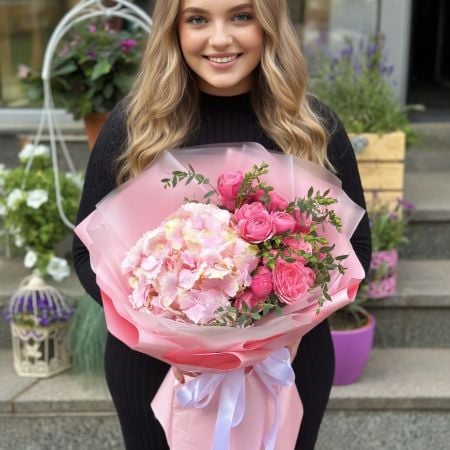
How to arrange a rose bouquet: a florist's rules
Even the most beautiful roses can end up in an unremarkable bouquet — or in an arrangement that looks luxurious and holds its shape for days. Here are the rules florists follow when making rose bouquets: number, shape, the spiral technique, greenery, colour combinations and wrapping. Everything else about types, colours and care is in our complete guide to roses.
Ready-made rose bouquets are in our large rose bouquets and roses in a box sections.

The main rules
How many roses
In Ukraine small bouquets traditionally have an odd number of flowers — 3, 5, 7, 11, 15; in large bouquets (from 15–25 roses) the rule no longer applies. Popular round numbers are 25, 51 and 101; how to make the largest of them is covered in "101 rose bouquet".

Bouquet shape
- Round — the classic: heads at one level form a dome.
- One-sided — tall roses at the back, short ones at the front; handy against a wall.
- Cascade — a trailing shape, mostly for weddings.
- Single-variety — roses of one variety and colour with no extras.
- Mixed — roses combined with other flowers and greenery.

The spiral technique
Florists build a bouquet in a spiral: each new stem is laid at the same angle while the bouquet is turned in the hand. This way the stems don't crush each other, the bouquet holds its shape and fans out nicely in the vase. The point where the stems cross is tied with ribbon or twine.
- Remove leaves and thorns below the binding point — they foul the water.
- Cut the stems at an angle to one length with a sharp knife.
- Put the bouquet straight into clean, cool water.

Greenery and extras
Eucalyptus, pistacia, ruscus, salal and aspidistra set off the roses and add volume. Small flowers such as gypsophila, limonium and stock add airiness. The key is not to overdo it: the roses should remain the stars.

Combining colours
- 1–3 shades within one palette look best: white and cream, pink and blush, red and burgundy.
- Contrasts (red with white, yellow with purple) suit bright festive bouquets.
- For the meaning of each colour see "What rose colours mean".
Wrapping and presentation
Kraft paper and felt suit a natural style, matte film a modern one and a hatbox a formal one. Wrapping should not hide the flowers: leave at least the top third of the heads visible.

Making the bouquet last
Change the water daily, trim the stems by 1–2 cm every other day and keep the bouquet away from radiators and fruit. More in "Rose bouquet care".
What you need to make a bouquet at home
- A sharp knife or secateurs for a clean angled cut.
- Floral tape or twine to secure the stems at the binding point.
- Greenery: eucalyptus, pittosporum, ruscus or salal for volume and framing.
- Wrapping paper or felt and a satin ribbon.
- A bucket of cool water so the flowers can drink before arranging.
Strip lower leaves and thorns in advance — the bouquet is easier to assemble and the vase water stays clean longer.
FAQ
How many roses should a bouquet have?
Small bouquets have an odd number; in large ones, from 15–25 roses, the rule doesn't apply.
Why build a bouquet in a spiral?
The stems don't crush each other, the bouquet keeps its shape and opens out nicely in the vase.
Which greenery goes with roses?
Eucalyptus, pistacia, ruscus, salal or aspidistra.

See photos in full size
Author: Maria Svitlovir
Graduated from Taras Shevchenko National University of Kyiv, Institute of Biology and Medicine (2001). BSc in Biology, MSc in Horticulture. Writes about plants, works at a garden centre selecting and repotting plants, and contributes to plant reference guides.
-
 Birthday Wishes for HusbandRead full2026-08-30
-

-
 Leather Anniversary WishesRead full2026-02-02
-
 Wedding ToastsRead full2025-11-18
-

-